
Gemini 4 Neon Wins a Blind Benchmark — but She Still Uses Claude
On November 18, Google launched Gemini 4 Neon, a new artificial intelligence model between its fast Hydrogen and its deepest Carbon — frontier-level reasoning at a lower price, Google says. A week later, one creator put it through a 25-task blind benchmark against OpenAI's and Anthropic's newest models. Neon won. Then she went back to using Claude.

What Neon is
Neon is the middle child of the Gemini 4 family. Carbon still handles the hardest, long-horizon projects; Hydrogen still handles fast everyday execution. Neon is built for the work in between: complex coding, analytical reasoning, and production-grade enterprise workflows — including orchestrating parallel Hydrogen subagents in Google Antigravity. It has the same one-million-token context window as Hydrogen and four thinking levels — low, medium, high (the default), and xhigh — so teams pay for the reasoning depth each task needs.
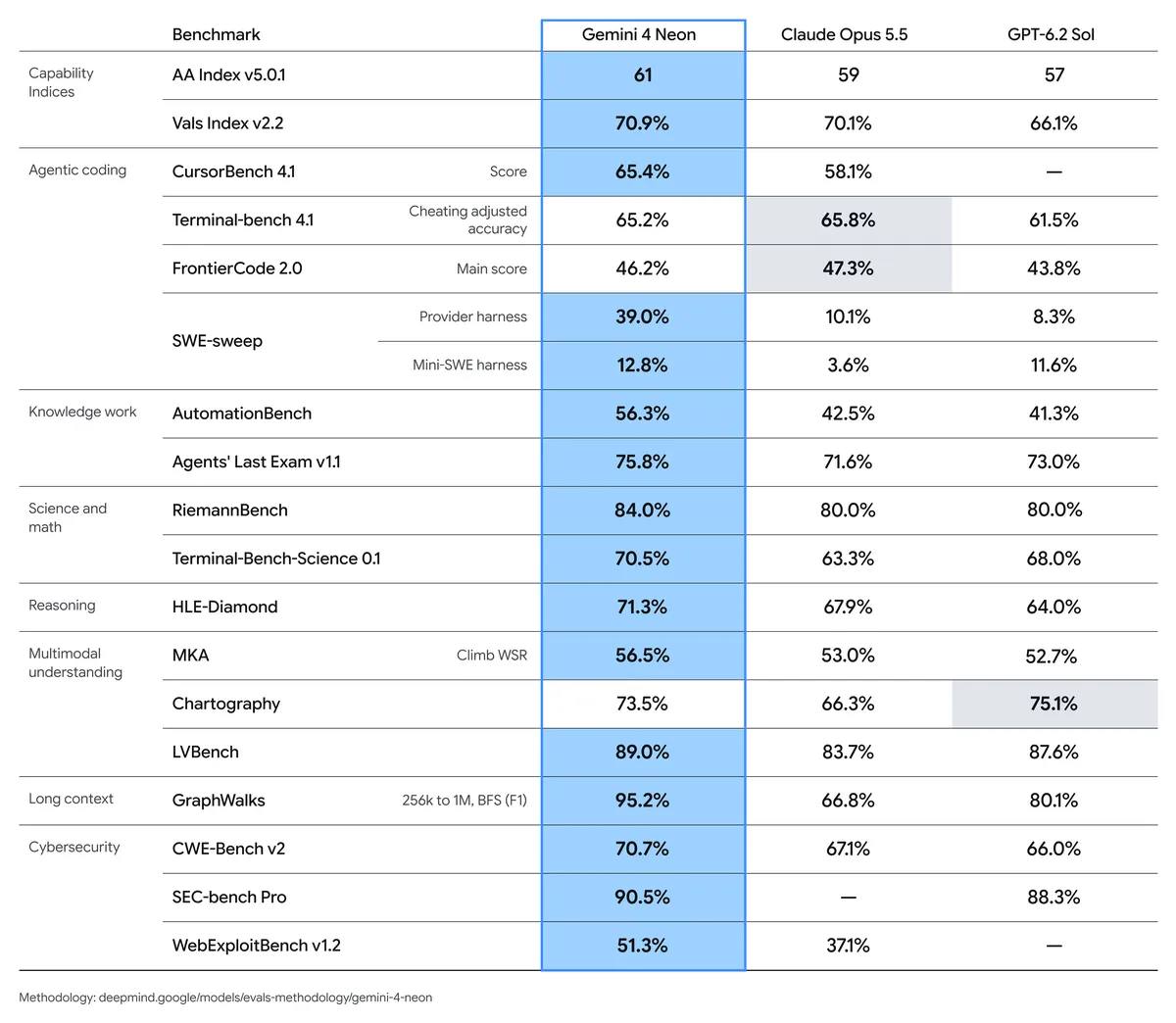
Google's headline number is 61 on the Artificial Analysis Intelligence Index at its xhigh thinking level — third overall, just behind larger models, and ahead of Claude Opus 5.5 (59) and OpenAI's GPT-6.2 Sol (57) on Google's own comparison table. It also ranks second on the Vals Index (70.9%), first on the Coding Agent Index (58.6), 65.2% on Terminal-Bench 4.1, and 39.0% on SWE-sweep inside Antigravity. On science it leads RiemannBench (84.0%); on cyber defense it leads SEC-bench Pro (90.5%) and CWE-bench v2 (70.7%). A cyber-tuned version is rolling out to trusted defenders through Google's Fairwind Program.
The price is $3 per million input tokens ($0.15 for cached input) and $15 per million output tokens — double Hydrogen's $1.50 and $7.50, and 25% cheaper than Carbon's $4 and $20 once Carbon's promotional pricing ends on November 30. At its default high thinking level, Google says Neon costs 32% less per task than Carbon. It is rolling out in the Gemini API in Google AI Studio and Android Studio, in Gemini for business, in Antigravity for paid AI Pro and Ultra subscribers, and in the Gemini app for Pro and Ultra subscribers — where it has replaced Argon in the model picker. Our Gemini 4 Hydrogen post covers the fast model below it; our AI Chatbots page compares Gemini with the rest.
The independent test
The launch numbers are Google's. The independent test comes from Claire Vo, who runs the How I AI channel (130,000 subscribers). In a video published November 25, she ran six frontier models — GPT-6.2 Astra and Sol, Claude Fable 5.2 and Opus 5.5, Gemini 4 Neon and Carbon — through her own 25-task benchmark: coding, writing, creative work, video, prototyping, and personal-assistant tasks. She graded blind, then ran two more models as judges (one Claude, one Gemini) and blended the scores.
Neon won, and by her account it was not close. It topped her blind scoring and her judges' scoring, and won where she expected Claude to dominate: creative tasks. Her examples: a family newspaper laid out as SVG illustrations, thumbnail designs, animated bots, and an interactive storybook where a ghost puts on a hat, blows out a candle, and falls asleep in bed. Neon also won video as a late surprise and came out best, with Opus 5.5, on five prototyping tasks, where she credits Google's experience building dense interfaces. On writing and assistant voice she preferred Neon and Fable 5.2. Coding, she says, barely separates the models — Astra came out best by about 0.1 over Opus 5.5 — so she tells CTOs to pick the cheapest model that does the job.
On cost she called Neon the cheapest in her test — first "the second least expensive," then correcting herself to "the most inexpensive," because Carbon, in her experience, didn't work. She gave no dollar figures, so that ranking is her relative impression, not a price comparison.
The twist: she still uses Claude
Here is the part that makes the video worth watching. Despite Neon winning her benchmark, Vo still reaches for Claude Opus 5.5 every day. She built a second ranking for that — an "Annoyance Bench" measuring how frustrating each model is to work with, drawn from her own chat sessions — and Opus 5.5 came out best on it. She says she never expresses frustration with it: it is fast, it is the easiest to work with, and it is her "emotional favorite, if not her technical favorite."
Neon, by contrast, was slow in her hands — "so extremely frustrating to use from a performance perspective," especially inside Antigravity, where the agent works in the background and she felt she had "wasted years of your life waiting for Neon." The outputs, she stresses, were "extremely good" — high quality, excellent results. The problem was the waiting. She also flags that Neon's prototypes still carry what she calls "slop tails" — a generic style that hasn't been trained out — though the layout and bones underneath are quite good once that is stripped away.
The tension is the story: the model that wins the benchmark is not automatically the model people reach for. Intelligence, cost, and how a model feels to work with are three different rankings, and on this test they produced three different winners.
What it doesn't prove
First, this is one creator's benchmark: 25 tasks, her taste, her harnesses, her judging setup. She published no scores table, and the video's own description says six models were scored blind while she says seven on camera — a small inconsistency that tells you how informal the setup is. Treat the win as one informed opinion, not a verdict.
Second, the cost claim has no numbers behind it. Google's price is $3 in and $15 out, and its own cost comparisons are against Carbon and other frontier models — not a claim that Neon is the cheapest model on the market. Fable 5.2, she says, costs more than twice as much as most of the others, but without prices that is direction, not arithmetic.
Third, her Carbon verdict — "basically just didn't work for me," ranked lowest, "failed" on animated bots — is her experience, and it cuts against Google's positioning of Carbon as the model for the hardest long-horizon work. Her speed complaint cuts the other way against Google's framing: Google sells Neon as "fast end-to-end task completion," while Vo found it slow inside Antigravity. Both can be true — an agent that works in the background feels slow even when the model itself is fast — but the video doesn't separate the two.
Fourth, Google's figures are Google's own testing, and the headline 61 comes at the xhigh thinking level, not the default most people will get. The video carries two sponsored segments (Parallel, a web-search API, and Jira Product Discovery), which is normal for a creator channel and worth knowing when a video praises a product.
The honest summary: Google has a strong middle model — cheaper than Carbon, deeper than Hydrogen, and now the deeper-analysis pick in the Gemini app for Pro and Ultra subscribers. An independent tester found it the best of six across her tasks, a real result — and also found it slow to work with, a real caveat. The benchmark winner and the daily driver are different jobs, and on this test they went to different models.
Sources & further reading
Checked November 26, 2026. Google, "Introducing Gemini 4 Neon," The Keyword, November 18, 2026 (updated November 23) — blog.google. 9to5Google, "Gemini 4 Neon launches: Carbon quality at Flash speeds, for AI Pro," November 18, 2026 — 9to5google.com. Claire Vo, "Gemini 4 Neon won my AI benchmark. I still choose Claude Opus 5.5," How I AI, November 25, 2026 — youtu.be. Artificial Analysis Intelligence Index — artificialanalysis.ai. All benchmark, speed and price figures are Google's own, from its November 18 announcement — not independently verified. The video's benchmark win and cost ranking are Claire Vo's own test, not Google's claims.
Google, Gemini, and Claude are trademarks of their respective owners, shown here for identification only. No endorsement is implied.