
Virtual and Augmented Reality, Explained
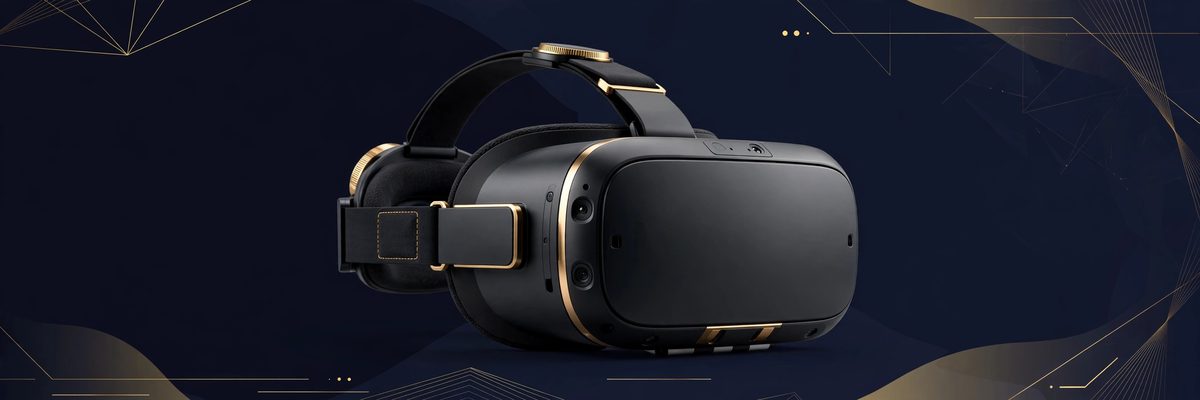
A virtual reality headset puts a screen in front of each eye and replaces the world with another one. An augmented reality device does the opposite: it lays digital things over the real world you can still see. Most headsets sold today do a bit of both — cameras show you your room, and virtual objects sit inside it — and the industry calls that mixed reality. The honest story of 2026 is that the metaverse pitch collapsed: Meta has lost more than $80 billion on it since 2020, and headset shipments fell by more than a third in two years. But the hardware survived, as a gaming and fitness device — and, at the top end, a very expensive way to watch movies and work. This page covers the headsets worth buying, what you actually do with each one, and what they cost — and one worth watching: Meta's VR Glasses, the 100-gram headset coming in spring 2027. Checked November 11, 2026. Smart glasses — the version of augmented reality you wear like ordinary glasses — are covered on our companion Digital Glasses & Eyewear page.
VR, AR and mixed reality, in one paragraph
Virtual reality (VR) blocks out the world entirely: two screens, one per eye, and software builds a place around you — a game level, a boxing ring, a cinema. Augmented reality (AR) keeps the real world visible and adds digital things to it: directions floating on the street, a repair manual hovering over the machine you're fixing. That is what smart glasses do. Mixed reality (MR) is the middle ground, and it is what nearly every headset on this page actually sells: outward-facing cameras film your room and show it to you on the screens inside, with virtual objects anchored in it — a game board on your coffee table, a browser window floating over your desk. Apple calls its version "spatial computing." XR is the umbrella term for all of it. One more split matters when you buy: standalone headsets have the computer built in (Quest, Steam Frame, Galaxy XR, Vision Pro), while tethered headsets borrow the power of something else — PlayStation VR2 needs a PS5, a PC VR headset needs a gaming PC, and Meta's VR Glasses are tethered to their own compute puck, which clips to your pocket.
The comparison — the headsets
| Headset | Price | Needs | Display (per eye) | Weight | Best for |
|---|---|---|---|---|---|
| Meta Quest 3S, 128GB | $349.99 | Nothing | LCD, 1832 × 1920 | 514g | Cheapest way into real VR |
| Meta Quest 3, 512GB | $599.99 | Nothing | LCD, 2064 × 2208 | 515g | Best all-round VR headset |
| PlayStation VR2 | $399.99 | PS5 | OLED, 2000 × 2040 | 560g | Best console VR |
| Valve Steam Frame, 256GB | $1,059 | Wi-Fi + PC for most games | LCD, 2160 × 2160 | 440g | Best for Steam libraries |
| HTC Vive Focus Vision | $999 | Nothing / PC optional | LCD, 2448 × 2448 | ~795g | Best for PC VR and eye tracking |
| Meta VR Glasses, 128GB | $1,299.99 (spring 2027) | Tethered puck | Micro-OLED, 2412 × 2288 | ~100g + ~300g puck | Most innovative — not out yet |
| Samsung Galaxy XR | $1,799.99 | Nothing | Micro-OLED, 3552 × 3840 | 545g + 302g battery | Best Android mixed reality |
| Apple Vision Pro (M5) | $3,699 | Nothing | Micro-OLED, ~3660 × 3200 | 600–650g + 353g battery | Best screens, worst value |
Prices are US list prices from the makers' own stores and November 2026 roundups, checked November 11, 2026 — confirm before buying. Two prices moved this year: Meta raised Quest prices on April 19, 2026 (Quest 3 from $499.99 to $599.99, Quest 3S from $299.99 to $349.99), blaming rising memory costs; Apple raised Vision Pro from $3,499 to $3,699 in June 2026 for the same reason, and some listings still show the launch price — flagged. Meta VR Glasses figures checked November 16, 2026.
The metaverse collapsed. The hardware survived.
The pitch was that we would all live, work and meet inside virtual worlds. It didn't happen. Meta bought Oculus for about $2 billion in 2014, renamed the whole company around the metaverse in 2021, and has since lost more than $80 billion in its Reality Labs division — $19.2 billion in 2025 alone, against revenue that mostly comes from Quest headset and accessory sales. Its flagship social world, Horizon Worlds, fell far short of its own targets; in March 2026 Meta announced it would pull Horizon Worlds from Quest headsets and focus on phones, then reversed the decision within two days after the backlash — but the app is now in maintenance mode, and Meta cut hundreds of Reality Labs jobs in early 2026. Across the industry, headset shipments fell 42.8% in 2025 (IDC), and Meta's own Quest shipments fell with them. What survived is narrower and real: games people actually play, fitness apps people actually sweat in, and enterprise training. Quest owners have spent over $2 billion on games and apps (Meta, March 2025). The headsets got good. The world inside them just never became the place we live.
 Meta Quest 3 and Quest 3S — the default buy
If you buy one VR headset in 2026, it is almost certainly a Quest. The Quest 3S (128GB) is $349.99 and the Quest 3 (512GB) is $599.99 after Meta's April 2026 price rise. The important fact is that they are the same machine where it counts: the same Snapdragon XR2 Gen 2 chip, the same 8GB of memory, the same controllers, the same store, the same games. What the extra $250 buys is optics — the Quest 3 has pancake lenses and sharper 2064 × 2208-per-eye displays with a wider 110° field of view, while the 3S reuses the older Fresnel lenses at 1832 × 1920 and about 96°. Battery is about two hours on the Quest 3 and about two and a half on the 3S, both weigh about 515g, and both do colour passthrough mixed reality. The library is the largest in standalone VR: Beat Saber, Asgard's Wrath 2, Batman: Arkham Shadow, Gorilla Tag, and the fitness apps below, plus the option to link to a PC for SteamVR. The Quest 2 and Quest Pro are both discontinued, so the 3S is now the entry point and the 3 is the flagship. The honest catch is the one the whole category shares: it is a 515-gram box on your face, and most sessions end after an hour or two.
Meta VR Glasses — the 100-gram headset, coming spring 2027
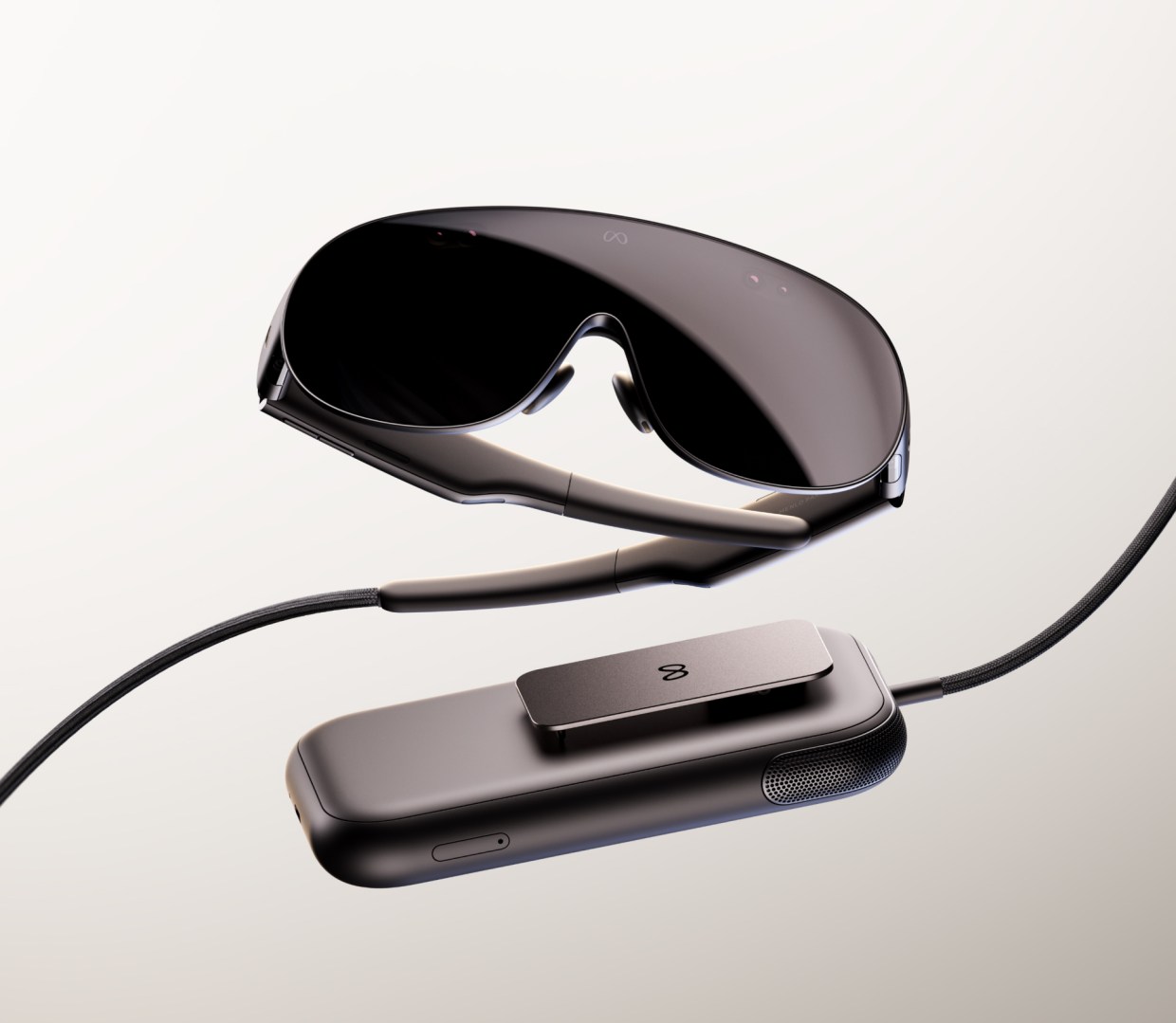
Meta announced the VR Glasses on September 23, 2026 at Connect, and they go on sale in spring 2027 for $1,299.99 (128GB) — no exact date, no preorders yet. The idea is simple: everything heavy moves off your face. The glasses themselves weigh about 100 grams — five times lighter than a Quest 3 — in a magnesium-alloy frame, while a ~300-gram puck clipped to your pocket holds the Snapdragon Reality Elite chip, the battery and the storage, connected by an optical tether. The displays are 5K micro-OLED at 2412 × 2288 per eye with 37 pixels per degree, Dolby Vision and Dolby Atmos built into the frames, and eye and hand tracking with no controllers needed — more than 75 games are playable with hand gestures from day one, plus Xbox Cloud Gaming. The honest trade-offs: the field of view is 70° × 66°, narrower than the Quest 3's roughly 110°; the puck battery lasts about three hours of media playback; and Touch Plus controllers are sold separately. Meta pitches it first as a cinema — it is the first IMAX Enhanced certified VR device — and a workspace, not a Quest replacement: Meta calls it a second VR product line, not a Quest 4, and every Quest app runs on it. Of the headsets on this page, it is the most innovative — the only one that splits the computer off your face entirely.
 PlayStation VR2 — the best console VR, with a question mark over it
PS VR2 launched in February 2023 at $549.99 — more than a PS5 cost at the time — and Sony permanently cut it to $399.99 in March 2025. At that price it is the best-looking VR you can buy without a gaming PC: dual OLED displays at 2000 × 2040 per eye, HDR, 90/120Hz, about 110° field of view, eye tracking, and Sense controllers with adaptive triggers and haptics. It connects to the PS5 with a single USB-C cable, and the games are the draw — Horizon Call of the Mountain, Gran Turismo 7 in VR, Resident Evil Village and Resident Evil 4, No Man's Sky — plus a $59.99 PC adapter (August 2024) that opens up SteamVR, and hand tracking added in 2025. The catches: it needs a PS5, it cannot play games made for the original PS VR, and the game library is smaller than the Quest's. And one flag before you buy: a November 3, 2026 report said Sony removed PS VR2 from its US and Japanese web stores; Sony has not officially announced a discontinuation. Check that it is actually in stock before you plan around it. The Gaming Platforms page covers the PS5 itself.
 Valve Steam Frame — the rumoured headset turned out to be real
For years the VR press called Valve's next headset "Deckard" and treated it as a rumour. It turned out to be real — under a different name. Valve announced the Steam Frame on November 12, 2025 and launched it on September 14, 2026 at $1,059 for 256GB and $1,299 for 1TB, controllers, a Wi-Fi 6E streaming adapter and Half-Life: Alyx included. It is a standalone SteamOS machine (Snapdragon 8 Gen 3, 16GB of memory, 2160 × 2160 LCD per eye, 72–144Hz, eye tracking, 440g) built first as a streamer: it plays your PC's Steam library wirelessly over Wi-Fi 7, using eye-tracked foveated streaming — the sharpest part of the image follows your gaze — and only a small slice of the Steam library runs on the headset itself. The old Valve Index is no longer being produced (Valve confirmed that on October 13, 2026). The catch is availability: Valve sells it only through a reservation queue, and some buyers won't get an order email until 2027. Best pick if your game library already lives on Steam and you want it on your face without a cable.
 Apple Vision Pro (M5) — the best screens money buys
Apple's second Vision Pro arrived on October 22, 2025 with the M5 chip, the R1 coprocessor, 16GB of memory and a redesigned Dual Knit Band — and the same $3,499 starting price it launched with, before Apple raised it to $3,699 in June 2026 (512GB is $3,899, 1TB is $4,199). Nothing else on this page looks like it: dual micro-OLED displays totalling 23 million pixels — about 3660 × 3200 per eye by teardown measurement, since Apple publishes no per-eye figure — plus twelve cameras, LiDAR, eye and hand tracking, and no controllers at all. It is a spatial computer more than a games machine: a giant virtual Mac display, Apple TV and Disney+ immersive video, and the sharpest passthrough on the market. The honest part is the sales: IDC figures reported by The Register put Vision Pro at roughly 390,000 units in 2024 and about 45,000 in 2025, after Apple halted production for most of the year. The game library is thin, the headset weighs 600–650g with another 353g of battery on a cable, and the battery lasts up to three hours of video. Best pick if you want the best displays in the category and the price doesn't stop you — and only then.
Samsung Galaxy XR — Android's answer, at half the Apple price
Samsung's Galaxy XR launched in October 2025 as the first headset running Google's Android XR, built with Google and Qualcomm, at $1,799.99 for its single configuration. The hardware is genuinely premium: dual 4K micro-OLED displays at 3552 × 3840 per eye (about 27 million pixels combined), a 109° field of view, Snapdragon XR2+ Gen 2 with 16GB of memory, eye and hand tracking, Wi-Fi 7, and Gemini built in. It weighs 545g with a 302g external battery good for about two to two-and-a-half hours. The pitch is that it runs everyday Android apps alongside made-for-XR apps — YouTube, Chrome, Google Play — so it feels less like a games console and more like a computer you wear. The catches: the motion controllers are a $250 optional extra, not included; the native XR game library is small next to the Quest's; and Samsung added its enterprise features (Android Enterprise, Knox device management) in April 2026, which tells you who the real first customers are. Best pick if you live in Google's world and want the Vision Pro experience at roughly half the price.
 HTC Vive Focus Vision — the PC VR pick
HTC's consumer flagship is the Vive Focus Vision, $999 (launched September 2024). On paper it out-specs the Quest 3: 5K LCD displays at 2448 × 2448 per eye, a 120° field of view, built-in eye tracking, automatic IPD adjustment (the lenses set themselves to your eyes), 16MP stereo colour passthrough cameras, 12GB of memory, and a hot-swappable battery. It runs standalone on a Snapdragon XR2, and a $149 DisplayPort kit wires it to a gaming PC for full PC VR at up to 120Hz. The honest flag is the company behind it: HTC's focus is now overwhelmingly enterprise — training, design review, location-based entertainment — and its consumer store and marketing are a shadow of Meta's. The headset is also the heaviest here at about 795g. Best pick if you play PC VR and want eye tracking and the sharpest LCD image in a standalone-capable headset, and you don't mind buying from a company that has mostly moved on from consumers.
What you actually do with one
Games. This is still the reason to own a headset. Beat Saber, Pistol Whip and Superhot on Quest; Gran Turismo 7 and Horizon Call of the Mountain on PS VR2; Half-Life: Alyx streamed to a Steam Frame; Asgard's Wrath 2 and Batman: Arkham Shadow on Quest 3. Our Gaming Platforms page covers the consoles these plug into.
Fitness. The quiet success story. Supernatural, Les Mills Bodycombat and FitXR turn the headset into a gym you can't skip — boxing, dance and HIIT in your living room, with no commute and no audience. This is the one use case where people keep coming back daily, and the Quest is the pick for it.
Movies. A virtual cinema screen the size of a wall, in a dark room, with nobody talking. Vision Pro and Galaxy XR are the best at this — their micro-OLED panels make a film look like a film — but any headset does the trick, and it is the most common thing owners actually do with a premium headset.
Work. The pitch every maker leads with, and the use case most people try once. A giant virtual monitor (Mac Virtual Display on Vision Pro, Immersed or Virtual Desktop on Quest) is genuinely useful for a focused hour — and genuinely tiring after two, with a half-kilo box on your face and a battery that lasts about as long as a meeting block. Treat it as a sometimes-tool, not a laptop replacement. Meta's VR Glasses, coming spring 2027, are built for exactly this — 100 grams on the face, the computer in a pocket puck — but they are not here yet.
Training and enterprise. The part of the market that is actually growing: flight simulators, factory training, medical practice, design review. HTC and Samsung sell into it directly; Meta and Apple sell into it sideways. If a headset is a work purchase, the enterprise features and device management matter more than the game store.
One practical note before you buy any of them: a minority of people get motion sickness in VR, especially in games where you move while standing still. If you can try one first — a friend's, a store demo — do. Comfort matters more than resolution after thirty minutes: weight, balance and the strap decide whether the headset comes out of the drawer.
What to watch
- Spring 2027: Meta's VR Glasses go on sale at $1,299.99 — see the comparison table and the section above.
- Into 2027: the Steam Frame reservation queue — Valve is still working through it, and the headset is the one to watch for PC gamers.
- More Android XR headsets: Samsung was first, but Google built Android XR as a platform for other makers. Expect cheaper headsets running the same software.
- No Quest 4 announced: Meta has said nothing about a Quest 4 — instead, its next headset is the VR Glasses (above). The Quest 3 and 3S are the line until spring 2027.
Before you decide
- Buy the ecosystem you already own. A PS5 means PS VR2. A Steam library means Steam Frame. A Mac means Vision Pro. A Google account means Galaxy XR. Nothing else means Quest.
- The $350 headset plays the same games as the $600 one. Quest 3S and Quest 3 share a chip and a store — the difference is the lenses, not the library.
- Weight matters more than resolution. 440g (Steam Frame) versus 795g (Focus Vision) is the difference between an hour and a headache.
- Battery is two to three hours, everywhere. Plan sessions around it; a battery strap is the first accessory most owners buy.
- Check the store before the specs. A headset is only as good as the apps you will actually open. Browse the Quest Store, SteamVR or visionOS first.
- Try one before you buy one. Motion sickness, glasses fit and head shape are personal — a demo answers in five minutes what a spec sheet can't.
- Glasses wearers: most headsets need prescription lens inserts (sold separately) for a comfortable fit — budget for them.
What "best for" means
There is no single best VR headset — the right one depends on what you already own and what you will actually do with it. "Best for" is the use case each one wins: Quest 3S for the cheapest way in, Quest 3 for the best all-round headset, PS VR2 for console owners, Steam Frame for Steam libraries, Focus Vision for PC VR with eye tracking, Galaxy XR for Google's world, Vision Pro for the best screens regardless of price, Meta VR Glasses for the most innovative headset, if you can wait until spring 2027. Compare on the library and the weight, not the resolution number alone.
Sources & further reading
Prices and figures checked November 11, 2026, from the makers' own stores and pages (Meta, Apple, Sony, Valve, Samsung, HTC) and November 2026 roundups: Quest 3/3S April 2026 price rise — Owl3D (checked November 8, 2026) and Tech Insider (June 2026); Vision Pro M5 — TechRadar and EveryMac (June 25, 2026 price rise to $3,699); PS VR2 — PlayStation Blog (March 2025 price cut to $399.99), Pengulin and iDevice (November 2026), and the November 3, 2026 store-removal report via Tech Insider; Steam Frame — Valve's November 12, 2025 announcement and September 14, 2026 launch, VR.org and Game Brief (October 30, 2026); Galaxy XR — Samsung's October 2025 launch, UC Today (ten-month review) and Pandromeda; Meta VR Glasses — Meta's September 23, 2026 newsroom announcement and VR Glasses product page (100g, 5K micro-OLED, 37 PPD, Snapdragon Reality Elite, up to 3 hours media playback, $1,299.99, spring 2027); per-eye resolution 2412 × 2288, 70° × 66° field of view, ~300g puck and Touch Plus sold separately — UploadVR, The Verge and Road to VR (September 2026); Meta's developer docs call the chip the Snapdragon XR2 Gen 3; VR Glasses figures checked November 16, 2026; Vive Focus Vision — Engadget/Notebookcheck (September 2024 launch) and ArborXR's 2026 buyers' guide; metaverse and market figures — Meta's 2025 annual filing (Reality Labs losses $16.1B in 2023, $17.7B in 2024, $19.2B in 2025), IDC headset shipments (down 42.8% in 2025) via Full Scale and NeuroDrift (November 2, 2026), Vision Pro unit figures (IDC via The Register), Horizon Worlds March 2026 announcement and reversal. Meta, Apple, PlayStation, Valve, Samsung and HTC are trademarks of their respective owners; logos are shown for identification only. Samsung appears as text only — no usable logo file was available. The Digital Glasses & Eyewear cross-link assumes that page's slug; confirm at deploy time.