
Gemini 4 Hydrogen Brings Artificial Intelligence to Every Google Search, Explained
On November 12, Google swapped the brain behind its search results. Gemini 4 Hydrogen, a new artificial intelligence model built for speed, is now answering questions in Google Search for everyone, free — the biggest model upgrade to Search yet, Google says. This page explains what changed, what the model is, and what Google's own numbers do and don't prove.

What happened
On November 12, 2026, Google introduced Gemini 4 Hydrogen and put it inside Google Search. The announcement came from Robby Stein, Google's vice president of product for Search: "Today, Google Search is bringing cutting-edge intelligence to everyone with Gemini 4 Hydrogen. This is the biggest model upgrade to Search yet." Hydrogen, Google says, "is now available globally in Google Search for all users" — no paid subscription needed to get the upgrade.
What changes in the answer: Search can now handle more nuanced questions, understanding what you need even when you ask in your natural flow of thought — questions with multiple parts, hard-to-understand typos, or highly specific requests. Its query fan-out technique, which runs several related searches behind one question, is upgraded, connecting you to a broader range of links. The answers get more visual, too — more images, comparison tables, and custom tools — across all supported AI Mode languages, not just English.
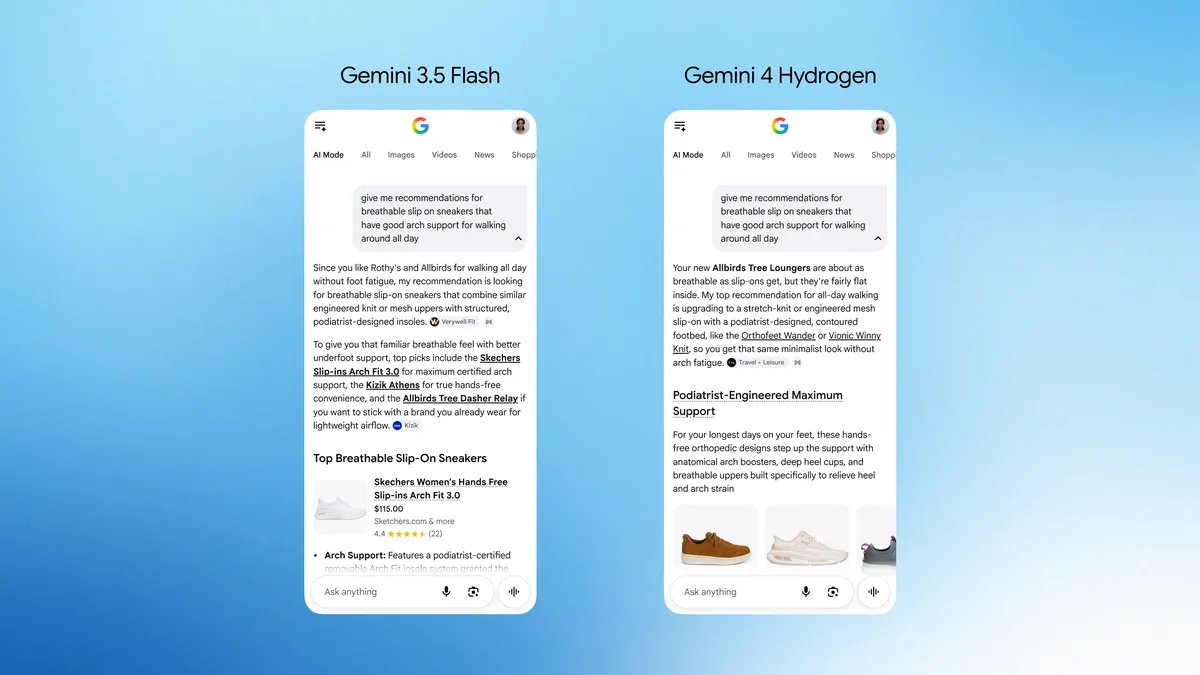
One detail comes from reporting rather than Google's blog posts: The Verge reports that Stein confirmed Hydrogen is now the default model in AI Mode, Google's conversational search experience, and that it handles the harder questions in AI Overviews. The same launch put Hydrogen in the Gemini app's model dropdown, in Google AI Studio and the Gemini API for developers, and in Gemini for business.
What the model is
Hydrogen is the third model in the Gemini 4 series, after Carbon and Argon — Google's frontier models for deep, long-horizon reasoning. Hydrogen is the one built for rapid execution: everyday coding, agentic work, and now Search. It succeeds Gemini 3.8 Flash as the everyday model, and it comes with a one-million-token context window and four thinking levels — low, medium, high (the default), and a new xhigh tier — so you only wait and pay for the reasoning depth a task requires.
The price is flat across that whole million-token window — $1.50 per million input tokens and $7.50 per million output tokens. On the Artificial Analysis Intelligence Index, Google says Hydrogen scores 51 at its default high thinking setting, against 50 for the bigger Argon — and reaches 54 at its highest xhigh setting. The speed claims are Google's own testing: Hydrogen finishes tasks 2.5 times faster than Gemini 3.8 Flash at its high default setting, more than triples its Terminal-Bench 4.1 score (57% against 18.2%), and cuts fabricated claims by more than five times.
| Model | Built for | Intelligence Index | Input price | What Google claims |
|---|---|---|---|---|
| Gemini 4 Hydrogen | Everyday coding, agents, Search | 51 (54 at xhigh) | $1.50 per million tokens | 2.5x faster than 3.8 Flash |
| Gemini 4 Argon | Deep, long-horizon reasoning | 50 | Not stated in this announcement | Google's frontier model |
| Gemini 3.8 Flash | Everyday work (previous model) | Not stated | Not stated in this announcement | Terminal-Bench 4.1: 18.2% |
Figures are Google's own, from its November 12 announcement; the Intelligence Index is Artificial Analysis's. Hydrogen output: $7.50 per million tokens.
Why it matters
Search is the artificial intelligence surface most people actually touch. Nobody had to download or pay anything for this change: the model answering the questions in the search box changed, for everyone, in one day. If you have used Google Search since November 12, you have already been talking to Gemini 4 Hydrogen — in AI Mode, and on the harder questions in AI Overviews — whether or not you knew its name.
For the person typing the question, the practical change is that Search now tolerates how people actually write: the multi-part question, the typo, the oddly specific request. Instead of breaking a hard question into several careful searches, you can ask it in one go and get an answer built from several related searches at once, with tables and images where they help, and links to sites the old search might never have surfaced. Our What Is AI? page explains what these models are, if the jargon is new — and our AI Chatbots page compares Gemini with the rest.
What it doesn't prove
First, every speed and benchmark figure here is Google's own testing, and Google is the company selling the model. The 51 against 50 on the Intelligence Index is one point on one index, at the thinking setting Google chose as its default — and the 54 at xhigh comes from a tier Google itself calls the highest, not the one most people will get. A one-point lead on a single benchmark is a thin reed to hang "smarter than Argon" on. Carbon and Argon are still the deep-reasoning models.
Second, the Search announcement gives no measured accuracy improvement and no comparison of response times — it describes how answers are built, not how much better they are. Google has not said which AI Overview questions qualify for Hydrogen, so not every Overview necessarily uses it, and in the Gemini app free users get Hydrogen through automatic model selection — you may not see it in the picker right away. And the oldest warning still applies — Google's own help page warns that AI responses can contain mistakes. A faster, more confident-sounding answer is still an answer that can be wrong.
The honest summary: Google put its fast, cheap model inside the world's most-used search box, free, for everyone. That is a real change in who gets to use capable AI. What it doesn't establish is that the answers are meaningfully more accurate — only that they are built faster, more visually, and from a wider trawl of the web.
Sources & further reading
Checked November 13, 2026. Google, "Introducing Gemini 4 Hydrogen for Agentic Workflows," The Keyword, November 12, 2026 — blog.google. Google, "Google Search upgrade: Gemini 4 Hydrogen features," The Keyword, November 12, 2026 — blog.google. Artificial Analysis Intelligence Index — artificialanalysis.ai. The "default model in AI Mode" detail comes from The Verge's reporting of Google's announcement, not from Google's blog posts themselves. All benchmark, speed and price figures are Google's own, from its November 12 announcement — not independently verified.
Google, Gemini, and Google Search are trademarks of Google LLC, shown here for identification only. No endorsement is implied.