Data Centers, Explained
Every photo you back up, every video you stream, every question you ask a chatbot — it all runs on a computer somewhere, in a building built for that one job. That building is a data center. They used to be invisible infrastructure. Now they are the biggest construction story in tech, the fastest-growing load on the power grid, and the reason a field near your town might suddenly be worth a fortune. Here is what they actually are, and what the numbers mean.
How it works, in one paragraph
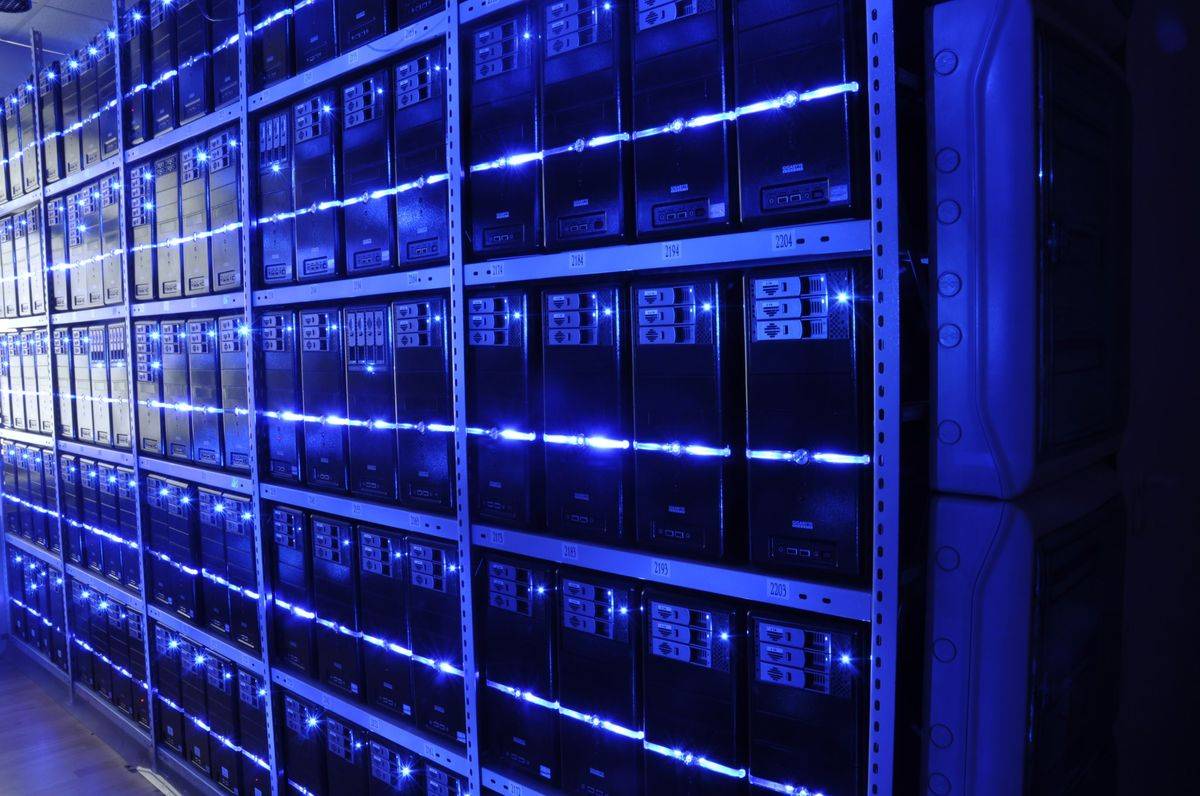
A data center is a building full of servers — racks of computers, stacked floor to ceiling — connected to fast internet, cooled constantly, and fed with backup power so they never switch off. Your phone does not hold the internet; it asks for it. When you open an app, stream a film, or send a message to an artificial intelligence (AI) chatbot, the work happens in one of these buildings, and the answer travels back to you in a fraction of a second. The cloud is not a cloud. It is these buildings, thousands of them, owned mostly by a handful of giant companies — and increasingly built for AI compute — the GPUs that train and run the models draw far more power than ordinary servers. Compute is the industry's word for that raw processing power: the chips, and the electricity they burn, to do the work.
The comparison
| Type | Who runs it | Typical size | What it is best for |
|---|---|---|---|
| Enterprise | One company, for its own IT | Under 1 MW to tens of MW | A bank, hospital or government running its own systems |
| Colocation ("colo") | A specialist operator, many tenants | Tens of MW per building | Renting space, power and cooling instead of building your own |
| Hyperscale / cloud | Amazon, Microsoft, Google and other cloud giants | About 100 MW to over 1 GW per campus | Running the cloud — storage, streaming, apps, AI at massive scale |
| Edge | Telecoms, cloud firms, local operators | Tens of kW to a few MW | Work that must happen close to you, with almost no delay |
| AI campus | Hyperscalers and AI companies | 1 GW and up for the largest | Training and running the biggest AI models |
Sizes are typical ranges, not limits — a hyperscale campus is a multi-building site, and the labels overlap: a hyperscale operator can also lease colocation space, and an AI campus is a hyperscale site built around AI workloads. Figures checked November 10, 2026.
Type by type
Enterprise — one company, its own computers
The original kind. A single organisation builds and runs a facility for its own IT — a bank's transaction systems, a hospital's patient records, a government's databases. It is the most controlled setup and the least flexible: the company pays for the building, the power and the staff, and it can only grow as fast as it can build. Many enterprises have been shrinking these and moving the work to the cloud instead, which is why this is now the quietest corner of the industry.
Colocation — renting space in someone else's building
Think of it as renting space in a well-equipped industrial building, but for computers. A colocation operator builds the facility — power, cooling, security, fibre connections — and tenants rent floor space and electricity in blocks, installing their own servers. It suits companies that want professional infrastructure without building a data center themselves, and it is also where smaller cloud companies and AI startups often start. The big names here include Equinix and Digital Realty.
Hyperscale / cloud — where the internet actually lives
These are the giants: campuses run by Amazon Web Services, Microsoft Azure and Google Cloud, built to expand in repeatable blocks as demand grows. A single campus can draw hundreds of megawatts — roughly the power of a small city — and the largest sites now being planned run into the gigawatts. Hyperscale operators held close to half of all the world's data center capacity at the end of 2025, according to Synergy Research Group. When you save a file to the cloud, stream a show, or use an AI chatbot, the work is almost certainly happening in one of these.
Edge — small, and close to you
Not everything can wait for a round trip to a giant campus hundreds of miles away. Edge data centers are small facilities placed near the people and devices using them, to cut delay to milliseconds. They handle things like mobile networks, content delivery, factory sensors and self-driving-car systems — anything where a tenth of a second matters. They are the smallest type on this page, from tens of kilowatts to a few megawatts, and they are often tucked into existing buildings rather than built as campuses.
AI campus — hyperscale, rebuilt for one workload
The newest type, and the one driving the current building boom. Training a large AI model and running it for millions of users needs specialised chips — graphics processors, or GPUs — packed far more densely than ordinary servers, and those chips draw far more power per rack. So an AI campus is a hyperscale site designed around power first: huge electrical capacity, liquid cooling piped directly to the chips, and a location chosen for the grid connection rather than for the users. Training can happen almost anywhere with enough power; running the finished model for users — inference — pulls capacity back toward cities, where the users are.
Inside a data center
Power — the whole game now
Servers turn nearly all the electricity they draw into heat, so a data center is really two machines: the computers, and the system that keeps them powered and cool. Power arrives at high voltage, passes through a substation, and is backed up by batteries that bridge the gap if the grid fails, plus diesel generators for longer outages. The industry measures efficiency with PUE — power usage effectiveness — which divides all the electricity entering the building by the electricity that actually reaches the computers. A PUE of 1.0 would be perfect; the global average is around 1.5, meaning about a third of the power goes to cooling and everything else; the best hyperscale sites get close to 1.1. Germany now legally requires new data centers to reach 1.2.
Cooling — water, air, or liquid on the chip
Cooling is where the water argument lives. The cheapest way to dump heat is evaporative cooling: water evaporates in a cooling tower and carries the heat away as vapour — efficient, but the water is gone. A 100 MW facility using evaporative cooling uses roughly 2 million litres of water a day on average, according to the US Congressional Research Service — about what a town of 20,000 to 30,000 people uses. The alternative is closed-loop cooling, where water circulates in a sealed circuit and is cooled by dry coolers: almost no water used, but more electricity spent on fans and chillers, so the PUE rises. That trade-off is the point: a very low PUE and a very low water figure rarely come together. The newest AI sites skip the argument by cooling the chips directly with liquid in a closed loop, and Microsoft announced a design in late 2024 that uses closed-loop cooling at all temperatures, which it expects to save more than 125 million litres of water per data center per year.
Staying up — redundancy, and what the tiers mean
A data center's promise is that it never goes down, and that promise is bought with duplication: extra power feeds, extra cooling, extra network routes, so any one failure has a spare ready. The Uptime Institute's Tier system rates that redundancy from Tier I (basic, one path, no spare) to Tier IV (fully duplicated, every path backed up). Most serious commercial sites aim for Tier III — one spare for every critical system, so maintenance can happen without switching anything off. The rating measures redundancy, not quality: a Tier IV building can still be badly run.
The numbers — electricity
This is the part that changed the story. For years, data centers were a small, steady slice of electricity demand. AI changed the slope.
- Global: data centers used about 415 terawatt-hours (TWh) of electricity in 2024 — about 1.5% of all the electricity in the world, roughly what the UK uses in a year. The International Energy Agency (IEA) expects that to more than double to about 945 TWh by 2030 in its base case, roughly Japan's annual total. The United States accounted for about 45% of that use, China 25% and Europe 15%.
- United States: US data centers used about 176 TWh in 2023 — 4.4% of all US electricity, up from 58 TWh in 2014 — according to the Lawrence Berkeley National Laboratory report for the US Department of Energy. Its 2025 update put 2024 at 192 TWh (4.7%), with a reference case of 649 TWh by 2030 — 11.8% of forecast US electricity — inside a scenario range of 521 to 843 TWh.
- What drives it: the IEA expects electricity use by AI's specialised servers to grow about 30% a year, against about 9% a year for ordinary servers — and the specialised servers account for almost half of the projected growth to 2030. A typical AI-focused data center uses as much electricity as 100,000 households, according to the IEA.
- The honest caveat: these are scenarios, not predictions. The Berkeley Lab range for 2028 alone spans 325 to 580 TWh, and the IEA's 2035 range runs from about 700 to 1,700 TWh depending on how fast AI is adopted and how much efficiency improves. Any headline that quotes one number as a certainty is skipping the range.
Why they are in the news — and why one might be coming to your town
Three things collided at once. First, AI made power the bottleneck: the chips exist, but connecting a gigawatt campus to the grid can take years — Lawrence Berkeley National Laboratory found waits for new grid connections have grown from under two years to more than four. Second, the sites are enormous and visible: hundreds of acres, a substation of their own, construction traffic for years. Third, the benefits and the costs land on different people. The construction brings hundreds of temporary jobs, but a finished data center runs mostly automated, so the permanent jobs are relatively few — dozens, not hundreds — while the power and water demands, and any effect on local electricity prices, are felt by everyone nearby. That is the argument playing out in town meetings across the US and Europe: tax revenue and investment on one side, grid strain, water use and higher bills on the other. There is no single answer — it depends on the site, the grid, and who pays for the upgrade.
Before you decide what to think
Read the number, not the headline
Data center figures come in two units that sound alike and mean different things. Terawatt-hours (TWh) measure energy used over a year — how much electricity actually flowed. Gigawatts (GW) measure capacity — how much power a site could draw at full tilt. A campus announced at "1 GW" is not using 1 GW around the clock; most sites run well below their rated capacity. And "announced" is not "built": many announced campuses never get financed, connected, or finished. Ask which number you are looking at, and whether it is a forecast, a scenario, or a measurement.
Questions to ask when one is proposed near you
Five questions cut through most announcements: how much power will it draw, and is the grid upgrade paid for by the operator or by other customers? How much water will it use, and is the cooling evaporative or closed-loop? How many permanent jobs, not construction jobs, will it bring? What happens to the site if the operator leaves — is there a decommissioning plan? And what did the operator promise in writing, not in a press release? The answers, or the lack of them, tell you more than the size of the investment figure.
The grid is the real story
The most important fact on this page is not how much electricity data centers use — it is how fast that use is growing, and where. In the US, data centers are close to half of all new electricity demand growth to 2030, according to the IEA. That is why utilities are racing to build transmission lines and power plants, why some operators are building their own on-site generation, and why the argument about who pays for the grid is now a political argument, not just an engineering one. The computers are the easy part. The power is the hard part.
What "best for" means — and what it doesn't
There is no single best kind of data center, because they are not competing products — they are different answers to different problems. An enterprise site is best when one organisation needs total control; colocation is best when a company wants professional infrastructure without building it; hyperscale is best when the workload is the whole internet; edge is best when delay is the enemy; an AI campus is best when the workload is one giant model. The mistake is treating "data center" as one thing. A server room, a colocation hall and a gigawatt AI campus share a name and almost nothing else — and the debate about them only makes sense once you know which one is being discussed.
Sources & further reading
Figures checked November 10, 2026. International Energy Agency, Energy and AI (April 2025): global data center electricity about 415 TWh in 2024 (1.5% of global electricity), base case about 945 TWh by 2030; AI-focused servers growing about 30% a year vs about 9% for conventional servers; US 45%, China 25%, Europe 15% of global use; a typical AI-focused data center uses as much electricity as 100,000 households. Lawrence Berkeley National Laboratory, 2024 United States Data Center Energy Usage Report (December 2024, for the US Department of Energy): US data centers 58 TWh in 2014, 176 TWh in 2023 (4.4%), projected 325–580 TWh by 2028 (6.7–12%); 2025 Update: 192 TWh in 2024 (4.7%), 2030 reference case 649 TWh (11.8%), range 521–843 TWh. US Congressional Research Service: a 100 MW facility uses roughly 2 million litres of water a day on average. Synergy Research Group: hyperscale operators held close to half of worldwide data center capacity at the end of 2025. Microsoft (late 2024): closed-loop cooling design expected to save more than 125 million litres of water per data center per year. Forecasts are scenarios with wide ranges — treat any single figure as one estimate, not a certainty.