
AI Is Now Building AI, Explained

An independent evaluator spent eleven weeks inside Anthropic and came out saying the lab is now improving its models at about twice the rate it managed a year ago — and that artificial intelligence itself is behind most of the speedup. The catch is as big as the headline: Anthropic redacted a majority of the evidence the evaluators called most informative. This page explains what the check actually found, how it was done, and what it doesn't prove.

What METR found
The evaluator is METR (Model Evaluation and Threat Research), a nonprofit that independently measures what artificial intelligence systems can do. On November 5, 2026, it published its assessment of Anthropic, "Independent Assessment of AI R&D Acceleration at Anthropic in October 2026." Its headline conclusion, in its own words: as of October 2026, Anthropic is "likely improving the capabilities of their models on well-specified tasks at around twice the rate they did between March 2024 and October 2025."
The hard number behind that judgment comes from AECI, Anthropic's version of the Epoch Capabilities Index, which rolls benchmark scores into a single number. Since October 2025, Anthropic's AECI scores have grown at an estimated 1.9 times the pre-October 2025 rate — a 95% confidence interval of 1.5 to 2.8 times — which METR glosses as roughly two years of historical progress compressed into one year. The index ran at about 15 points a year before October 2025, and about 29 a year after it. In plain terms, that is what a two-times acceleration means: two years of progress in one. Anthropic made about as much progress on these benchmarks in the past year as it did in the two years before that — roughly the span from Claude 2.1 to Sonnet 4.5.
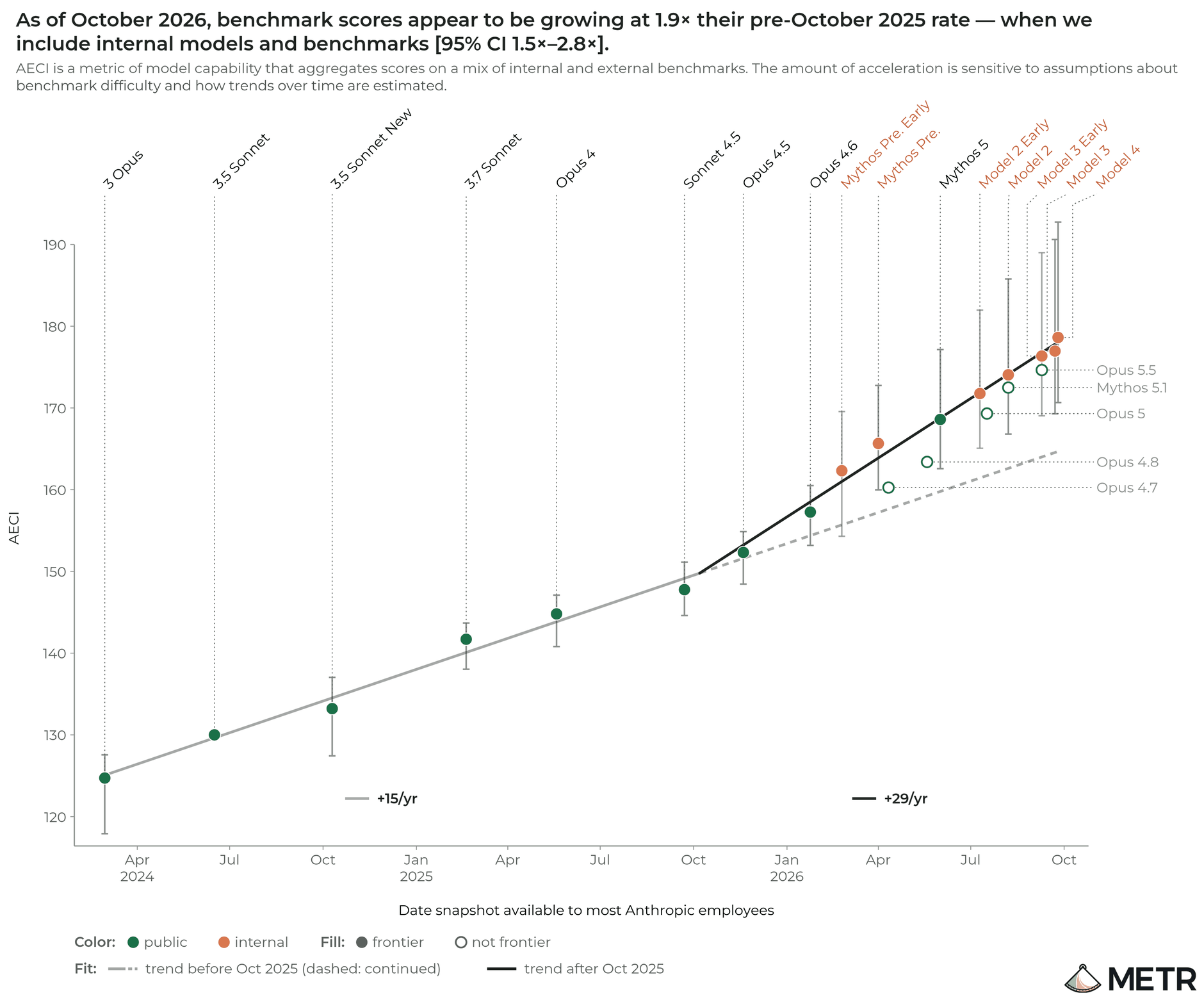
METR's guess at the cause: a majority — "perhaps ≈80%" — of the current acceleration is due to AI itself, with substantial uncertainty. It is confident about one negative: the acceleration was not driven by faster growth in training compute. Staff self-reports point the same way — in informal polls, Anthropic staff put their productivity uplift from the latest internal model at about 12 times by October 2026, though METR calls that very loose evidence. And Anthropic's own filing says its engineers now ship eight times as much code per quarter as they did from 2021 to 2025.
How they know
METR spent eleven weeks inside Anthropic, from August 12 to October 29, 2026, with what it called unprecedented access to internal data: pretraining and reinforcement-learning metrics, compute figures, benchmark scores for internal models, AI speedup analyses, forecasts — and interviews with relevant staff. The team was small, about two and a half full-time researchers. Its estimate is higher than the 1.7 times in Anthropic's own Haiku 5.5 system card, mainly because METR included data on newer, unreleased models. Robustness checks — different benchmark sets, model dating, and inclusion choices — put the acceleration anywhere from 1.1 to 2.9 times.
How the work actually changed
The numbers say the pace doubled. The interviews say how. METR and Anthropic interviewed researchers in detail about how much of the acceleration in their own area came from AI use. The estimates ranged widely, but centered around two times — the same answer as the benchmark number, reached from a completely different angle.
The pattern is AI assistance, not AI autonomy: researchers working with AI systems, rather than AI systems doing the research on their own — though METR notes signs that fully autonomous contributions will play a larger role soon. And the acceleration was not all AI. METR judges that non-AI factors — hiring, data improvements, algorithmic discoveries, resolved bottlenecks — likely played a large role in late 2025, with AI's share growing over time to the roughly 80 percent it guesses today. The self-reported uplift tells the same story of a rising curve: staff put it at about 1.2 times for Claude 3.7 Sonnet in early 2025, climbing to about 12 times for the newest internal model by October 2026.
The catch
Anthropic had the contractual right to redact any non-public information in the report, and it used it. METR's own words: "Anthropic redacted a majority of the evidence we found most informative for these conclusions." Anthropic described the redactions as "aimed at removing confidential information that could accelerate other AI developers." METR is blunt about what that means: "this report does not achieve transparency about evidence," and the public has to rely on METR's judgment "much more than would be ideal."
The uncertainty runs deeper than the redactions. METR's team disagreed internally, and says it would not be surprised if the true acceleration were closer to 1.3 times or 3 times the historical rate. Its understanding of the bottlenecks changed several times during the work, so it is not confident in its current read. And it lists both directions of error: it could be underestimating the acceleration (growth rates rose further recently; AECI understates real-world impact) or overestimating it (non-AI factors in late 2025; AECI's focus on verifiable tasks; an unusually low early growth rate).
Why it matters
If AI keeps speeding up AI research, progress compounds: each generation of models helps build the next one, faster. Anthropic says each new  Claude directly accelerates the development of the next, and that its models increasingly help develop newer versions of themselves. The end of that road is recursive self-improvement — an AI system designing its own successor. Anthropic says it is "not there yet."
METR found no clear bottleneck — in algorithmic progress, training compute, experiment compute, or data — that would slow the trend over the next twelve months, though it is not confident in that read: its understanding of the bottlenecks changed several times during the work. If nothing is about to slow the trend down, the acceleration can compound — each generation of models helping build the next one, faster — and METR puts it as a significant risk that further progress could lead to even faster acceleration over the coming year. That sharpens a tension Anthropic's own chief executive, Dario Amodei, flagged in a September 12 essay, urging the industry to "slow the pace at which we improve the capabilities of AI models" so safety work can keep up. The report does not establish that safeguards have fallen behind — but it does put an outside measurement on the speed of the thing safety work has to keep up with.
Timing is worth knowing, not concluding from: the report landed on November 5, days before Anthropic's IPO roadshow could begin on November 10, with its S-1 prospectus public since October 26.
What it doesn't prove
First, this is one lab. Across all frontier developers — OpenAI, Google, and xAI included — the same AECI measure accelerated about 1.4 times, not 1.9. Second, it covers well-specified, measurable tasks. METR is explicit that the acceleration may be limited to those tasks, and that it is uncertain how the finding translates to broader, messier work. Third, it is a single assessment whose best evidence is redacted. The honest summary is not "AI is now accelerating itself." It is: an independent checker thinks it probably is, at one lab, on measurable tasks — and the public is taking that judgment largely on trust.
Sources & further reading
Checked November 13, 2026. METR, "Independent Assessment of AI R&D Acceleration at Anthropic in October 2026," November 5, 2026 — metr.org. Dealroom News, "AI is now building AI: METR finds Anthropic developing models twice as fast," November 8, 2026 — dealroom.co. Anthropic's S-1 prospectus (public October 26, 2026) and Haiku 5.5 system card, cited via METR and Dealroom. Figures are METR's estimates with the uncertainty ranges given above — not settled facts.
Anthropic and Claude are trademarks of Anthropic, PBC, shown here for identification only. No endorsement is implied. The AECI chart is METR's, reproduced with credit.